Loading...
Please wait while we load the content...

Loading...
Please wait while we load the content...
Stay informed about our latest publications, calls for proposals, and special announcements. As a subscriber, you'll also enjoy exclusive member discounts of 10%-20% on all orders. Join our community of scholars, librarians, and readers today.


Availability
In stock
ISBN
9798881902100
Edition
1
Publication Date
March 4, 2025
Physical Size
236mm x 160mm
Illustrations
17 Color
Number of Pages
222
Currency
Quantity
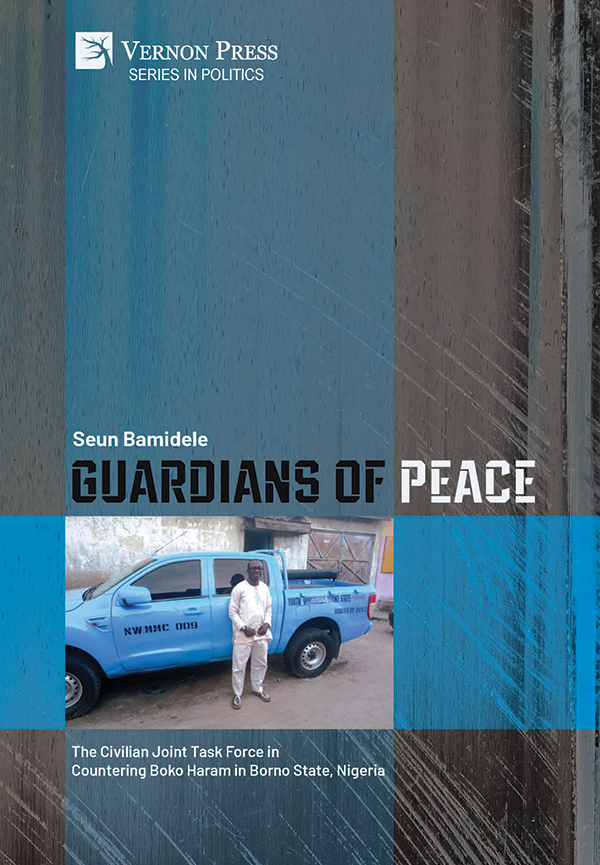
Postcolonial instability in Africa has produced a wealth of literature on peace and conflict, including Boko Haram, a notorious insurgency group in northeastern Nigeria. However, we rarely find a book devoted to counter-insurgency peacekeeping by an irregular civilian movement that was untrained for warfare. Dr Bamidele’s book is unique for empirically examining how the militarisation of the Civilian Joint Task Force contributes to peacekeeping in Nigeria’s Borno State. It presents a nuanced analysis of counter-insurgency from below, which illuminates thorny issues in civilian-military alliances, such as funding, liaison, and human rights violations. The policy insights in the book provide a platform for integrating informal counter-insurgency groups into the State’s security architecture. In this alone, Dr Bamidele fills a critical gap in peace and conflict literature in sub-Saharan Africa.
Professor Dr. Anthony C. Diala
Law Faculty
University of the Western Cape, South Africa
After reading Seun Bamidele's “Guardians of Peace: Civilian Joint Task Force in Countering Boko Haram in Borno State, Nigeria,” it became quite evident to me that he has achieved in unearthing what linguists refer to as the "inevitable anomalies of So-Seem-Said." In this case, the economic, political, religious and social institutions in Nigeria are thoroughly broached apropos thought and reality. The "So-Seem-Said" triad in the book entails (1) how Nigeria's economic, political, religious and social institutions exist interdependently; (2) how the institutions appear to the various groups in the country, regardless of their autonomy; and (3) how we must talk about the institutions, no matter what or whether we think about them or how they really exist.
Prof. Dr. Abdul Karim Bangura
American University's Center for Global Peace, Washington DC
Discover books that expand on the themes explored in this work—titles that engage with similar questions, intersecting disciplines, and complementary perspectives to deepen understanding and broaden the conversation.
Browse all titles