Loading...
Please wait while we load the content...

Loading...
Please wait while we load the content...
Stay informed about our latest publications, calls for proposals, and special announcements. As a subscriber, you'll also enjoy exclusive member discounts of 10%-20% on all orders. Join our community of scholars, librarians, and readers today.


Availability
In stock
ISBN
9781648898235
Edition
1
Publication Date
January 30, 2024
Physical Size
236mm x 160mm
Number of Pages
268
Currency
Quantity
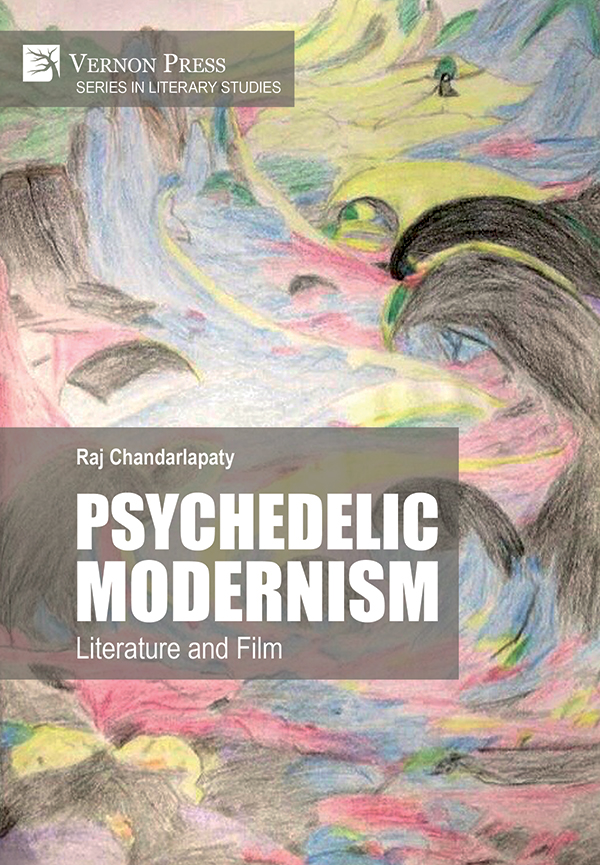
Dr. Raj Chandarlapaty’s “Psychedelic Modernism: Literature and Film” is one of the few books that seriously engages with the controversial notion that drug use can induce significant application to the creation of art that can, in turn, challenge society’s values. In his extremely sophisticated analyses, Chandarlapaty chooses to ponder the claims of the proselytizers of drug use and question the easy dismissal of their claims while simultaneously avoiding the romanticizing of drug use to bring about social change. He examines literature and documentary films that focus on drug use with the desire to better understand the interplay of these artistic mediums within societal discourse.
Kurt Hemmer
Harper College
Introduced by by Jiddu Krishnamurti’s claim, “You must understand the whole of life, not just one little part of it,” Raj Chandarlapaty’s extensively researched "Psychedelic Modernism" is an ambitious attempt first to survey ways that authorities and literary figures in Western society have responded to psychedelic substances and then to consider how various influential writers and filmmakers have imagined the possibility that widespread use of psychedelics could change the fundamental nature of society, itself. While most academic and popular discussions have centered on how individuals have used psychedelics to gain insights into themselves, which potentially enhanced their self-knowledge and facilitated personal and spiritual growth, Chandarlapaty goes beyond that to investigate how important institutions and individuals have regarded the ways that mind-altering experiences could potentially alter Western society.
Chandarlapaty invokes a wide range of figures from literature and film to create a thought-provoking context for thinking about how, historically, psychedelic experiences have been regarded by authorities and other influential figures. His perspective is not limited solely to the Beats, who are perhaps the best-known authors to address mind-altering experiences and their ramifications. He also devotes chapters to Aldous Huxley, who in 1951 expanded public awareness in his book Doors of Perception, after which the rock group The Doors was named, and to Neal Cassady, Albert Hofmann, the Swiss scientist who is credited with first synthesizing LSD from ergot, Timothy Leary, who predicted, “Within fifty or a hundred years, the Catholic Church will be using LSD as a sacrament,” Grateful Dead frontman Jerry Garcia, Beat author Ken Kessey, science fiction writer Phillip K. Dick, and Carlos Castaneda, whose shamanic experiences involving peyote captured the imagination of college students and others in the late 1960s and 1970s.
Chandarlapaty also points to Thomas Pynchon’s Gravity’s Rainbow and to Karl Marx, the 19th century co-author of The Communist Manifesto who disapproved of mind-altering experiences because, “firstly. . .the exterior sensuous world increasingly ceases to be an object belonging to his work, a means of subsistence for his labor; secondly, since it increasingly ceases to be a means of subsistence in the direct sense, a means for the physical subsistence of the worker.”
And to show the interplay among literature, society, and psychedelic experiences, Chandarlapaty aptly quotes from Kesey’s 1961 Book of Haikus, which appeared during China’s disastrous Great Leap Forward: “Mao Tse Tung has taken/ too many Siberian sacred/ Mushrooms in Autumn.”
Overall, "Psychedelic Modernism" brings needed attention to the presence and impact of mind-altering experiences on twentieth-century Western thought, something that has been largely overlooked in academic discussions of the period and university courses about it.
Prof. Richard Schwartz
Discover books that expand on the themes explored in this work—titles that engage with similar questions, intersecting disciplines, and complementary perspectives to deepen understanding and broaden the conversation.
Browse all titles
Oliver Bock and Isabel Vila-Cabanes (Eds.)
View more
Jolene Mairs Dyer, Conor McCafferty, and Cahal McLaughlin (Eds.)
View more