Hardback
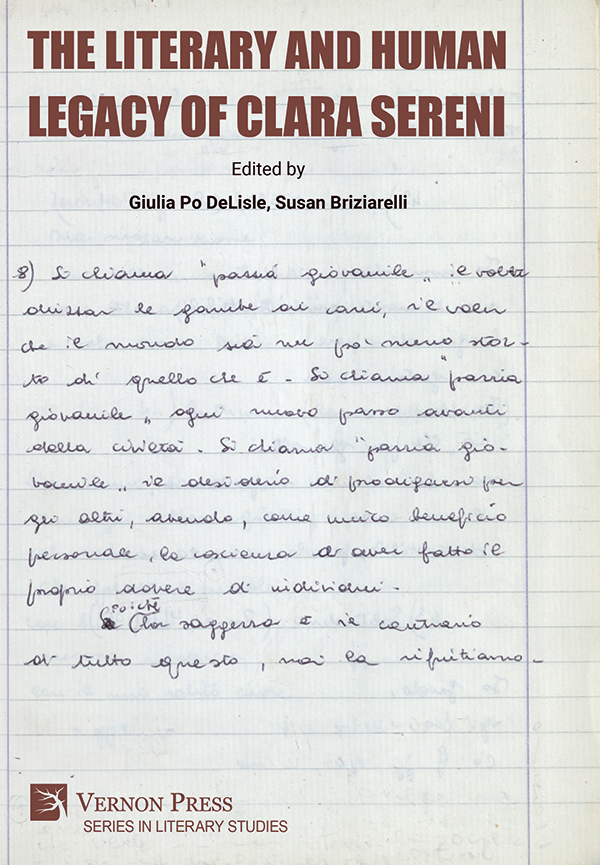
The Literary and Human Legacy of Clara Sereni
Nicole Paronzini, Giulia Po DeLisle, Susan Briziarelli, Mirna Cicioni, Giovanna Miceli Jeffries, Simonetta Milli Konewko, Scott Lerner, Margherita Losacco, and Puma Valentina Scricciolo
Clara Sereni lived an extraordinary life in extraordinary times. Born in Rome in 1946, she grew up in a prominent family of Jewish intellectuals whose influential role in Italian politics and in the anti-fascist resistance could not but inform Sereni’s own future social and political engagement. Coming of age during the turbulent Sixties, Sereni embraced the struggle for women’s rights, social justice, and political reform, championing Eduardo Galeano’s notion that utopia always stands at the horizon, and one must keep walking to reach it.
Activist, journalist, writer, translator, but also musician, disability rights champion, home-maker, and wife; her multiple and often conflicting roles emerge in a rich and multifaceted writing, increasingly balanced between the public and the private, history with a capital “H”, and personal memoir.
Her first major success, ‘Casalinghitudine (Keeping House)’, explores the juncture of the public and the personal as important historical moments merge with her workaday memories of cooking. Her remarkable historical novel ‘Il Gioco dei Regni (The Game of Kingdoms)’ traces her family history from the early 20th century through the post-war period, chronicling their personal lives and their involvement in Italian politics and Jewish intellectual life. Subsequent works such as ‘Taccuino di un’ultimista’ (‘Notebook of a Meek Woman’) and ‘Passami il sale’ (‘Pass me the Salt’) tackle the difficulties of negotiating life as a political figure, wife, and mother of a disabled son. In works such as ‘Eppure’ (‘And Yet’), ‘Le Merendanze’ (‘Afternoon Snacks’) and ‘Una storia chiusa’ (‘A Closed Story’), as well as ‘Il lupo mercante’ (‘The Mongering Wolf’) and ‘Via Ripetta 155’ (‘155 Ripetta Street’), she again intertwines private experiences and public circumstances, raising questions related to gender, class, disability, the elderly, and sustainability.
This is the first volume that brings together the critical aspects of Clara Sereni’s work, providing a comprehensive view of the writer, the intellectual, the politician, and the woman.
As we reflect on the 20th century, Sereni’s long-spanning writing career stands as an important document of its struggles, its conflicts, and, like Sereni herself, its enduring idealism.