Loading...
Please wait while we load the content...

Loading...
Please wait while we load the content...
University of Exeter, England
Hazik Mohamed, Esra Güler, Halil Seyidoğlu, Aatos Hallipelto, Cumhur C. Küçüközmen, Mahir Fisunoğlu, Metin Akyüz, Gökhan Karhan, Mücahit Çayın, M. Ali Seyidoğlu, M. Uzair Zulkifly, İsmail Özsoy, Birol Görmez, Hatice Özkurt Çokgüngör, Aukje van Loon, Sevgi İneci, Paraskevi Kyrilla, Angeliki Nestoroudi, Themis Anthrakidis, Nikos Astroulakis, John Marangos, Necati Çoban, Fatih Yeter, Nalan Kangal, İlhan Eroğlu, Irfan Kalayci, Jeremy Kwok, and Mehmet Kaya
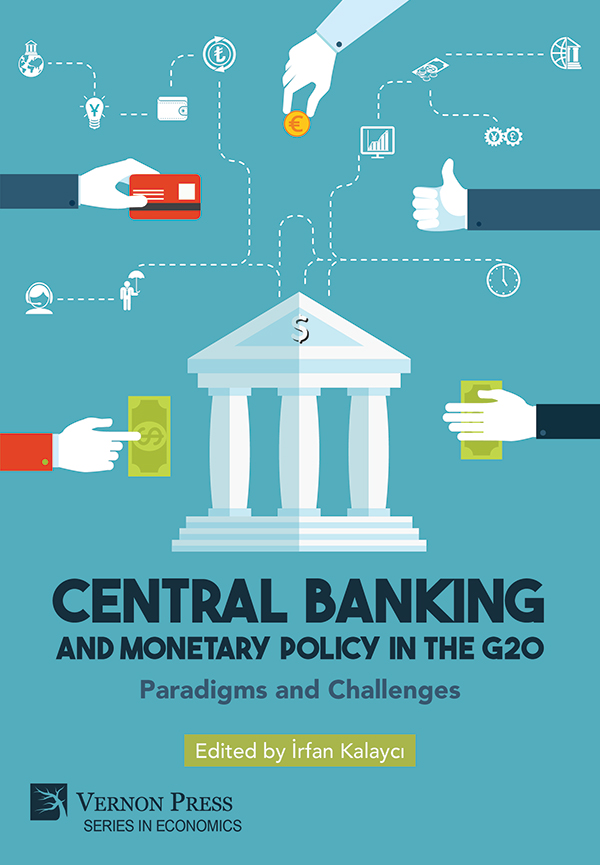
Behind productive and prosperous economies are independent central banks that implement effective monetary policies. This observation is especially valid for the G20, which comprises the world’s top twenty economies in terms of gross domestic product and the largest stakeholders of the global economic system. These economies include Argentina, Australia, Brazil, Canada, China, France, Germany, India, Indonesia, Italy, Japan, Mexico, Russia, Saudi Arabia, South Africa, South Korea, Turkey, the United Kingdom, the United States, and the European Union. Three features of this book, which focuses on central banking and monetary policy in the G20, an intergovernmental platform, stand out: Firstly, as contemporary theories and global practices confirm, the main purpose of central banks is to ensure monetary and price stability, not despite the government but in cooperation with it. This principle is strongly emphasized here. Governments, which must maintain fiscal discipline, are key to the success of central banks in combating inflation and deflation. Secondly, since the authors of the book chapters come from various countries and academic institutions, the book offers a range of perspectives and intellectual richness. Without deviating from the book's main axis, the authors examine the changing paradigms in central banking and the increasing challenges of monetary policy. This examination is based on developed and emerging economies, integrations, financial organizations, and economic crises within the G20, informed by significant sources. Thirdly, this book offers university researchers, professional business practitioners, and curious readers the opportunity to explore and reflect on new concepts such as green central banking, digital money, and interest-free monetary policies, which have gained prominence in the wake of the global COVID-19 pandemic, alongside mainstream topics. It is hoped that this book, consisting of 14 chapters, will inspire those who wish to conduct new and renewed academic studies on global central banks and monetary policies and will fill a gap in the literature.
Jeremy Kwok, Ernesto Guerra García, José G. Vargas-Hernández, Joana Vassilopoulou, Meltem Yavuz Sercekman, Kurt April, Mustafa F. Özbilgin, Rifat Kamasak, Chandra Sekhar Patro, Sushant Bhargava, Arti Sharma, Xiaodan Zhang, Sachin Sinha, Deepti Sinha, Rachna Bansal, Rauno Rusko, Chandan Maheshkar, Vinod Sharma, Yvonne Kamegne, Joyram Chakraborty, James Phelan, Rupa Rathee, Madhvi Lamba, Tarika Nandedkar, Amit Kumar, Rachna Bajaj, and Gaurav Gupta
As organizations and businesses continue to expand in the cross-border and multicultural markets, culture needs to be taken into consideration. At present, culture introduces significant changes in the core assumptions of business practices and skill expectations. Gaining cross-cultural compatibility is now a serious concern for businesses and organizations. Appreciating the overall view of cross-cultural business environment, 'Handbook of Research on Cross-culture Business and Management' is a significant attempt to contribute a piece of knowledge on different aspects of cross-cultural business and management, facilitating practitioners and academicians to explore different cross-cultural business practices and develop competencies. This book will be a unique source for cross-cultural business and management practices, helping people of both industry and academia to understand the cross-cultural business environment and improve management practices.
Jeremy Kwok
‘Macroeconometric Models for Portfolio Management’ begins by outlining a portfolio management framework into which macroeconometric models and backtesting investment strategies are integrated. It is followed by a discussion on the theoretical backgrounds of both small and global large macroeconometric models, including data selection, estimation, and applications. Other practical concerns essential to managing a portfolio with decisions driven by macro models are also covered: model validation, forecast combination, and evaluation. The author then focuses on applying these models and their results on managing the portfolio, including making trading rules and asset allocation across different assets and risk management. The book finishes by showing portfolio examples where different investment strategies are used and illustrate how the framework can be applied from the beginning of collecting data, model estimation, and generating forecasts to how to manage portfolios accordingly. This book aims to bridge the gap between academia and practising professionals. Readers will attain a rigorous understanding of the theory and how to apply these models to their portfolios. Therefore, ‘Macroeconometric Models for Portfolio Management’ will be of interest to academics and scholars working in macroeconomics and finance; to industry professionals working in financial economics and asset management; to asset managers and investors who prefer systematic investing over discretionary investing; and to investors who have a strong interest in macroeconomic influences on their portfolio.