Loading...
Please wait while we load the content...

Loading...
Please wait while we load the content...
Goethe-Universität Frankfurt
Terri Geis, Samantha Kavky, Krzysztof Fijalkowski, Kristoffer Noheden, Adam Jolles, Tor Scott, Christina Heflin, Victoria Ferentinou, Julia Drost, Olivier Penot-Lacassagne, Brianna Mullin, Anna Reid, and Andrea Gremels
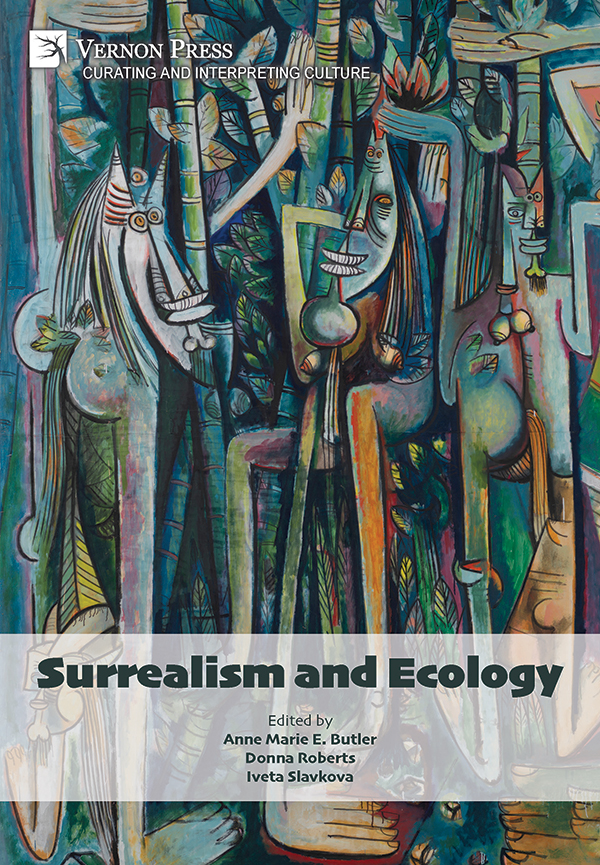
'Surrealism and Ecology' is the first volume to consider the intersections of these two fields. It addresses the contribution of the avant-gardes in thinking about the relationship of humans with their environment in the context of massive environmental upheaval in the twentieth century. This volume explores the significant role of Surrealist artists and writers within the history of critical thinking about nature and environment over the last hundred years. It approaches ecology both as a mode of thinking about the many interconnections of life and as a way of experiencing and knowing the world. The relationship of humans with their environment is of paramount significance within contemporary discourse, and the contribution of the historical avant-gardes to this topic remains largely underexplored. In addressing this gap, the book presents a diverse selection of analyses of the ways in which the Surrealists have thought about and represented nature and the human place within it. It emphasises how Surrealism’s interventions in connecting seemingly distinct domains of thought and phenomena can be understood as relevant to more recent developments in the practice of ecological thought. Surrealist practices and the academic field of Surrealism studies are broad in scope and include not only visual art, but also poetry and literature, film, philosophy, exhibition design, and experimental practice. This volume includes contributions from established and developing scholars working across disciplines and locations, who address such varied practices and engage with analyses from multiple perspectives. The international and trans-Atlantic history of Surrealism is well-represented in this book, with over half the texts exploring the work of European Surrealists in exile during the Second World War or the art and environmental and political activism of Surrealists in the Caribbean and throughout the Americas.
Michelle Man, Gabriel Weisz Carrington, Claire Dean, Felicity Gee, Alicia Kent, Penny Sharman, Julia Salmerón, Gerogina Sowerby, Andrea Gremels, Tara Plunkett, Alessia Zinnari, Catriona McAra, Roger Shannon, James Hewison, and Jon Lee
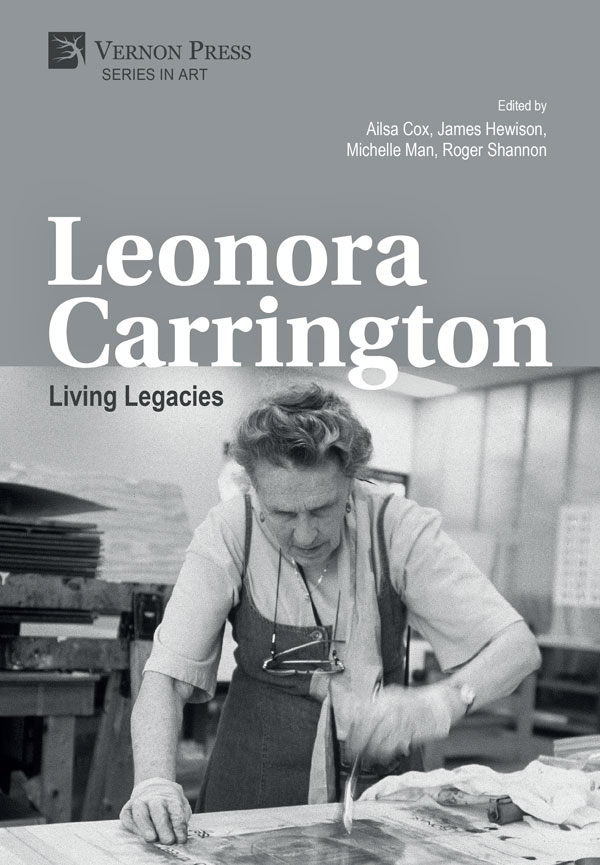
The English born artist and writer Leonora Carrington (1917–2011) has received much critical acclaim and achieved stellar status in Mexico, where she lived and worked for most of her life, having fled Europe via Spain in tormenting circumstances. Leonora Carrington: Living Legacies brings together a collection of chapters that constitute a range of artistic, scholarly and creative responses to the realm of Carrington emphasizing how her work becomes a medium, a milieu, and a provocation for new thinking, being and imagining in the world. The diversity of contributions from scholars, early career researchers, and artists, include unpublished papers, interviews, creative provocations, and writing from practice-led interventions. Collectively they explore, question, and enable new ways of thinking with Carrington’s legacy. Wishing to expand on recent important scholarly publications by established Carrington researchers which have brought historical and international significance to the artist’s legacy, this volume offers new perspectives on the artist’s relevance in feminist thinking and artistic methodologies. Conscious of Carrington’s reluctance to engage in critical analysis of her artwork we have approached this scholarly task through a lens of give and return that the artist herself musingly articulates in her 1965 mock-manifesto Jezzamathatics: “I was decubing the root of a Hyperbollick Symposium … when the latent metamorphosis blurted the great unexpected shriek into something between a squeak and a smile. IT GAVE, so to speak, in order to return.” (Aberth, 2010:149). In adopting her playful conjecture, this publication seeks to bring Carrington and her work to further prominence.