Loading...
Please wait while we load the content...

Loading...
Please wait while we load the content...
Bucknell University, USA
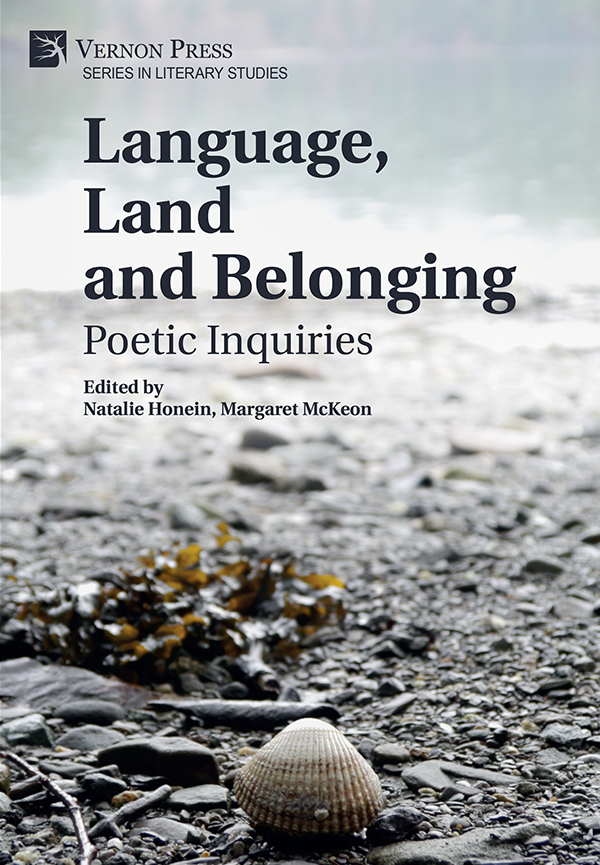
Paula Aamli, Jan Buley, Will Morin, Kathryn Ricketts, Joseph Naytowhow, Wanda Campbell, Adam Garry Podolski, Marcy Meyer, Daniela Elza, Robert Nellis, Nicole D. Morris, Adrian Downey, Ángel L. Martínez, Holly Tsun Haggarty, Maya T. Borhani, Emma Green, Anita Lafferty, Margaret McKeon, Natalie Honein, Adam Vincent, Sarah MacKenzie-Dawson, Andrejs Kulnieks, Sandra Filippelli, Alexandra Fidyk, and Pauline Sameshima
This volume takes up themes emergent from the 7th International Symposium on Poetic Inquiry (ISPI) which invited participants to reflect on the United Nations Declaration of 2019 as the International Year of Indigenous Languages. In this refereed collection, Indigenous and non-Indigenous authors use poetic inquiry to explore the importance of their ancestral languages and lands, and consider the Indigenous languages and peoples of the lands where they live. Situated in diverse global contexts, poet-researchers examine the intersectionality of their languages, their lands, and their sense of belonging. They offer relational understandings of, and articulate obligations for, their environment and communities. Through stories of shared generational pain and renewal, each author brings the reader into their world of learning and growth. They do this through discourses of belonging and relational responsibilities that tie them to a place, a genealogy. As a method of study that incorporates poetry into academic research, poetic inquiry is concerned with particularity, complexity, and transformations. Making research more visceral and evocative, it invites researchers to examine and engage with the knowledge they seek through a continual process of questioning, welcoming, and awareness. In this volume, poetic inquiry helps to honor languages and histories taken for granted; it allows looking back in order to reexamine, redefine, and make sense of the present and its shortcomings while reimagining a different future. This work seeks to reclaim, through poetic inquiry, wisdom of language, land, and belonging.
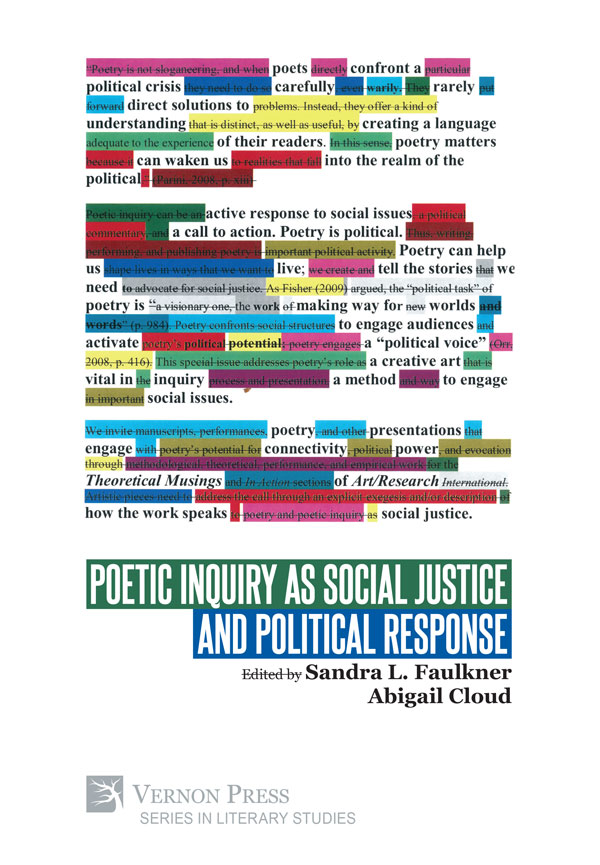
Alexandra Fidyk, Pauline Sameshima, John J. Guiney Yallop, Heidi van Rooyen, Anne McCrary Sullivan, Sheila Stewart, Sheila Squillante, Molly H. Sherman, Gisela Ruebsaat, Bonnie Nish, Robert Christopher Nellis, Heather McLeod, Margaret McKeon, Sarah MacKenzie-Dawson, Mark D. McCarthy, Sandra L. Faulkner, Sean Wiebe, Laura Apol, Robin Barre, Lee Beavington, Maya Borhani, Kimberly Dark, Sandra Filippelli, Amanda N. Gulla, and Natalie Honein
This volume speaks to the use of poetry in critical qualitative research and practice focused on social justice. In this collection, poetry is a response, a call to action, agitation, and a frame for future social justice work. The authors engage with poetry’s potential for connectivity, political power, and evocation through methodological, theoretical, performative, and empirical work. The poet-researchers consider questions of how poetry and Poetic Inquiry can be a response to political and social events, be used as a pedagogical tool to critique inequitable social structures, and how Poetic Inquiry speaks to our local identities and politics. The authors answer the question: “What spaces can poetry create for dialogue about critical awareness, social justice, and re-visioning of social, cultural, and political worlds?” This volume adds to the growing body of Poetic Inquiry through the demonstration of poetry as political action, response, and reflective practice. We hope this collection inspires you to write and engage with political poetry to realize the power of poetry as political action, response, and reflective practice.