Browse by Subject
Explore our complete collection
Status
Format
Language
Publishing
Resources
News & Updates
About Vernon Press
Subjects
Series
Publication Status
Type
Loading...
Please wait while we load the content...
Armah Ralph Nii Armah, Avishek Datta, Damba, T. Osman, Joseph Amikuzuno, Christopher Gordon, Adelina Mensah, Elaine Tweneboah Lawson, Franklin Kodzo Avornyo, Mohammed Tiyumtaba Shaibu, Suhiyini Issah Alhassan, Mustapha Abubakar Sadiq, Ramatu M. Al-Hassan, John K. M. Kuwornu, Abdulrazak Karriem, Sampson Osei, Ali Essossinam, Mairong Frederick Nsaikii, Bankui Andrew Dzeaye, Mbu Dora Nyuykighan, Yaw Bonsu Osei-Asare, Derick T. Adu, Njodzeka Gilbert Njodzeka, Moye Eric Kongnso, and Suiven John Paul Tume
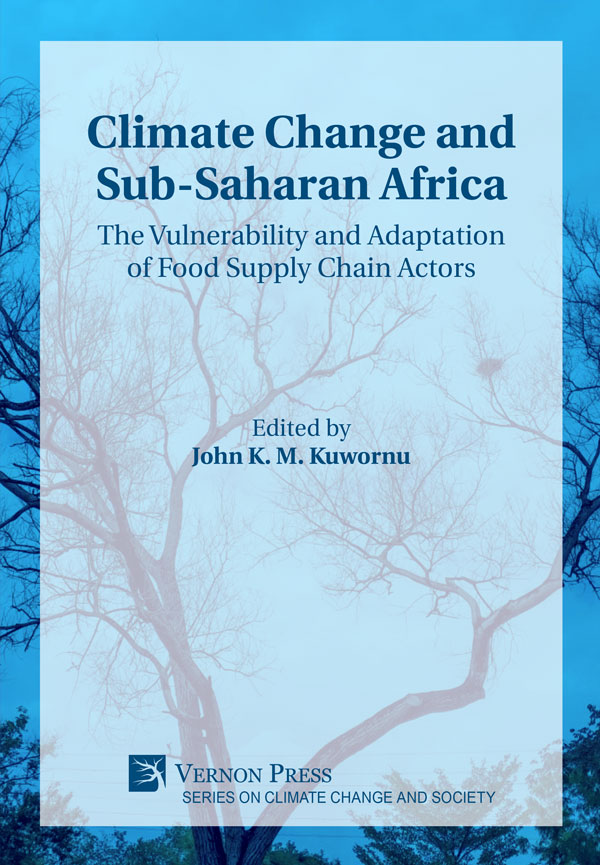
The adverse effects of climate change and climate variability have become some of the biggest environmental and socio-economic challenges for society, and for food supply chain actors, in particular. Serving as a serious inhibitor to the attainment of food security, climate change poses a fundamental threat to the availability, accessibility, stability and utilization of nutritious food and quality drinking water. The threat of this global phenomenon is not only apparent from the difficulties faced by all food supply chain actors, but is also felt acutely by households dependent on semi-subsistence agriculture. As evidenced by numerous studies conducted by the academic community, governmental and non-governmental organisations, climate change and climate variability will have disastrous effects on entire food supply chains across the world. This edited volume looks to address: How vulnerable are food supply chain actors to climate change and climatic variability? What adaptation strategies are they adopting? How is the resilience of food supply chains being supported? Are they being financed and/or supported by international organizations to cope with climate change? And what governmental support are they receiving to help cope with climate change? This book is an essential resource for students, lecturers, researchers, agribusinesses, marketing firms, agricultural institutions, climate change adaptation institutions, policymakers and many others with an interest in agricultural development and the global food industry.