Loading...
Please wait while we load the content...

Loading...
Please wait while we load the content...
St. Andrews University, USA
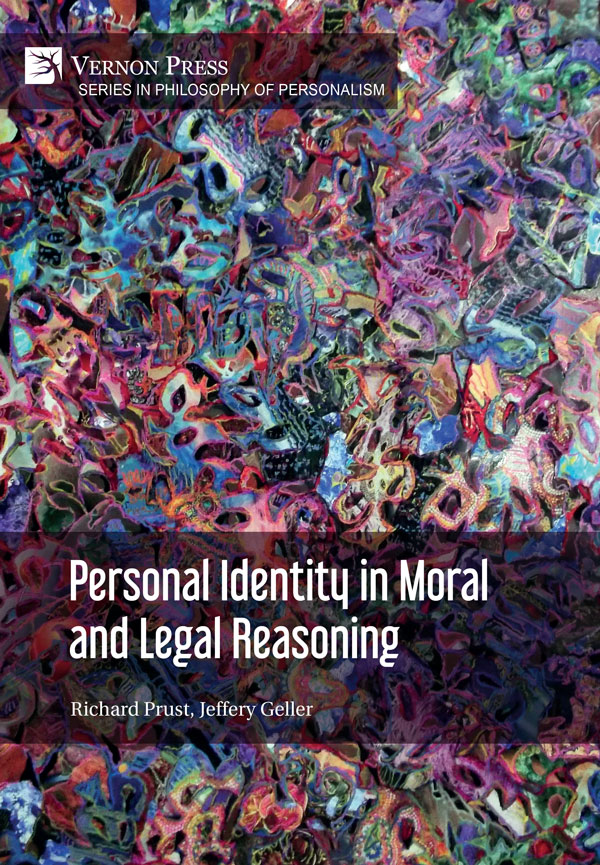
Richard Prust and Jeffery Geller
Many questions about moral and legal judgments hinge on how we understand the identity of the agents. The intractability of many of these questions stems, this book argues, from ignoring how we actually connect actions with agents. When making everyday judgments about the morality or legality of actions, we do not use Aristotelian logic but what is termed “character logic”. The difference is crucial because implicit in character logic is an understanding of personal identity that is both coherent and intuitively familiar. A person, as we conceptualize him in moral and legal contexts, is a character of resolve. By unpacking what it means to be a character of resolve, this book reveals what underwrites our most fundamental beliefs about a person’s rights and responsibilities. It also provides a new and useful perspective on a variety of issues about rights and responsibilities that perennially occupy philosophers. This book discusses the following: • How we can make better sense of “human rights” if we think of them as “personal rights”. • How the right to be civilly disobedient, in contrast with ordinary law-breaking, can be justified as a personal right. • What basis we have for holding that someone’s responsibility is diminished. • How it makes sense to hold someone responsible for acting irresponsibly. • How it makes sense to distinguish a juvenile offender from someone who should be tried in criminal court. • What kind of correction we should expect from our correctional institutions and how we should design them to achieve that. By making explicit the axioms of character logic and exploring their origins and justification, the book provides a conceptually powerful tool for interpreting the protocols of a person-respecting society.
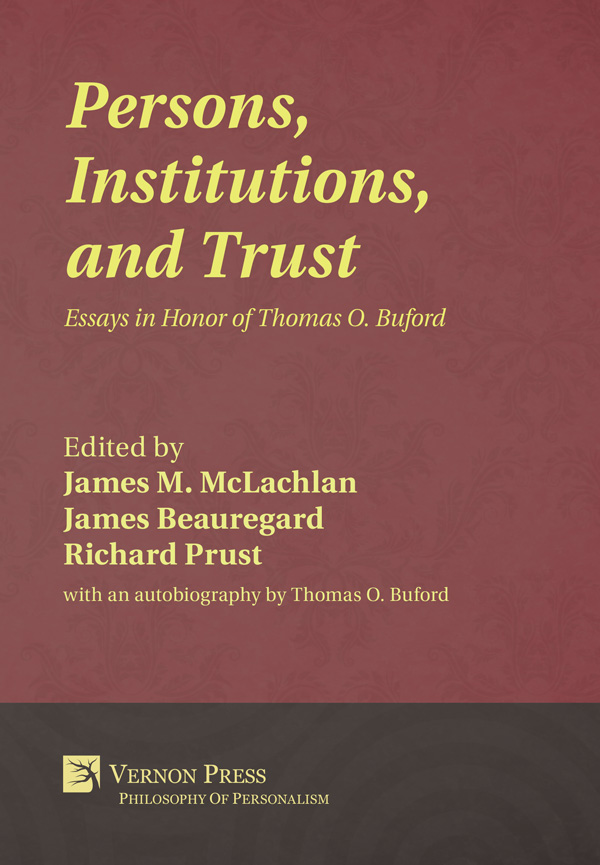
Essays in Honor of Thomas O. Buford
Richard Prust, Eugene Long, John Scott Gray, Mason Marshall, Thomas O. Buford, Randall Auxier, Nathan Riley, J.Aaron Simmons, James M. McLachlan, and James Beauregard
The papers presented in this volume honor Thomas O. Buford. Buford is Professor Emeritus in Philosophy at Furman University where he taught for more than forty years. Several of the papers in this volume are from former students. But Professor Buford is also a pre-eminent voice of fourth generation Personalism, and Boston Personalism in particular. Personalism is a school of philosophical and theological thought which holds that the ideas of “person” and “personality” are indispensable to an adequate understanding of all metaphysical and epistemological problems, as well as are keys to an adequate theory of ethical and political human interaction. Most personalists assert that personality is an irreducible fact found in all existence, as well as in all interpretation of the meaning of existence and the truth about experience. Anything that seems to exist impersonally, such as inanimate matter, nevertheless can exist and have meaning only as related to some personal being. The Boston Personalist tradition was inaugurated by Borden Parker Bowne and continued by Edgar S. Brightman, Peter Bertocci, John Lavely, Carol Robb, and Martin Luther King, Jr.
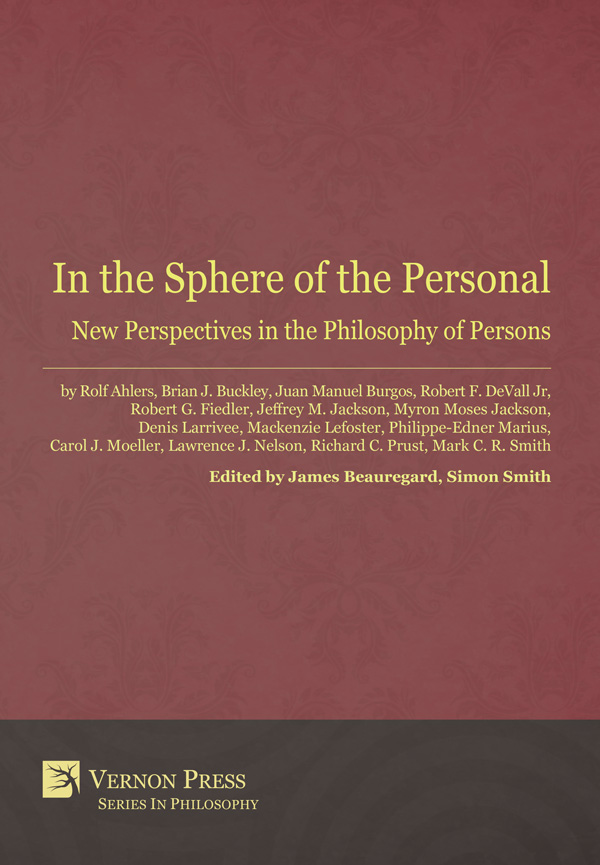
James Beauregard, Moeller Carol, Denis Larrivee, Rolf Ahlers, Jeffrey M. Jackson, Mark C. R. Smith, Robert F. Devall Jr., Brian J Buckley, Robert G. Fiedler, Lawrence J. Nelson, Juan Manuel Burgos, Philippe - Edner Apostol - Marius, Mackenzie Lefoster, Richard Prust, Simon Smith, and Myron M. Jackson
The papers in this collection were originally presented at the 13th International Conference on Persons, held at the University of Boston in August 2015. This biennial event, founded by Thomas O. Buford and Charles Conti in 1989, attracts a host of international scholars, both the venerable and the aspiring. It is widely regarded as the premier event for those whose research concerns the philosophical tradition known as ‘personalism’. That tradition is, perhaps, best known today in its American and European manifestations, although there remains a small but fiercely defended stronghold in Britain. Personalism is not an exclusively Western development, however; its roots are also found in India, China, and Japan. What unites these disparate intellectual cultures may seem quite small. There is little, if any, methodological or doctrinal consensus among them. They are all, however, responses to the impersonal and depersonalising forces perceived to be at work in philosophy, theology, and, most recently, the natural and political sciences. Their common aim is to place persons at the heart of these discourses, to defend the idea that persons are the metaphysical, epistemological, and moral ‘bottom line’, the vital clue to knowledge of self, reality, and all conceivable values. The authors in this collection do not simply reflect upon this tradition, they put it to work on a range of philosophical and theological problems, both classical and contemporary; problems of free will, personal identity, and the nature of reality, as well as the very current concerns of environmental philosophers, bio- and neuro-ethicists. Their perspectives, too, are many and varied, so offer profound insights into key debates among other philosophical traditions, such as the Kantian, Hegelian, phenomenological, and process schools.