Loading...
Please wait while we load the content...

Loading...
Please wait while we load the content...
University of Prince Edward Island, Canada
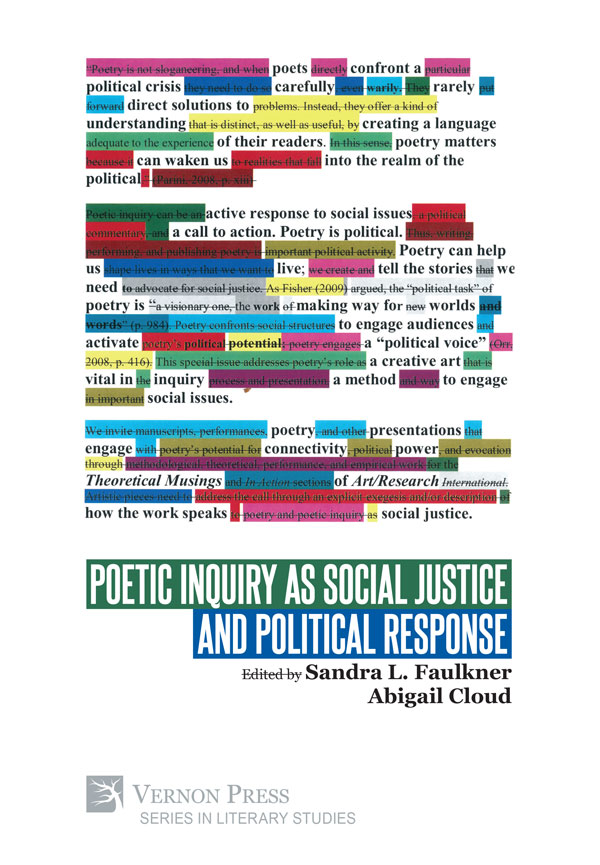
Mark D. McCarthy, John J. Guiney Yallop, Margaret McKeon, Heather McLeod, Robert Christopher Nellis, Bonnie Nish, Gisela Ruebsaat, Molly H. Sherman, Sheila Squillante, Sheila Stewart, Anne McCrary Sullivan, Heidi van Rooyen, Sarah MacKenzie-Dawson, Natalie Honein, Amanda N. Gulla, Sandra Filippelli, Kimberly Dark, Maya Borhani, Lee Beavington, Robin Barre, Laura Apol, Sean Wiebe, Sandra L. Faulkner, Alexandra Fidyk, and Pauline Sameshima
This volume speaks to the use of poetry in critical qualitative research and practice focused on social justice. In this collection, poetry is a response, a call to action, agitation, and a frame for future social justice work. The authors engage with poetry’s potential for connectivity, political power, and evocation through methodological, theoretical, performative, and empirical work. The poet-researchers consider questions of how poetry and Poetic Inquiry can be a response to political and social events, be used as a pedagogical tool to critique inequitable social structures, and how Poetic Inquiry speaks to our local identities and politics. The authors answer the question: “What spaces can poetry create for dialogue about critical awareness, social justice, and re-visioning of social, cultural, and political worlds?” This volume adds to the growing body of Poetic Inquiry through the demonstration of poetry as political action, response, and reflective practice. We hope this collection inspires you to write and engage with political poetry to realize the power of poetry as political action, response, and reflective practice.
Pauline Sameshima, Patricia Maarhuis, and Sean Wiebe
Winner of the '2020 Society of Professors of Education Outstanding Book Award' Parallaxic Praxis is a research framework utilized by interdisciplinary teams to collect, interpret, transmediate, analyze, and mobilize data generatively. The methodology leverages the researchers’ personal strengths and the collective expertise of the team including the participants and community when possible. Benefits include the use of multi-perspective analyses, multi-modal investigations, informal and directed dialogic conversations, innovative knowledge creation, and models of residual and reparative research. Relying on difference, dialogue, and creativity propulsion processes; and drawing on post-qualitative, new materiality, multiliteracies, and combinatorial, even juxtaposing theoretical frames; this model offers extensive research possibilities across disciplines and content areas to mobilize knowledge to broad audiences. This book explains methods, theories, and perspectives, and provides examples for developing creative research design in order to innovate new understandings. This model is especially useful for interdisciplinary partnerships or cross-sector collaborations. This book specifically addresses issues of research design, methodology, knowledge generation, knowledge mobilization, and dissemination for academics, students, and community partners. Examples include possibilities for scholars interested in doing projects in social justice, community engagement, teacher education, Indigenous research, and health and wellness.
Pauline Sameshima, Patricia Maarhuis, and Sean Wiebe
Winner of the '2020 Society of Professors of Education Outstanding Book Award' Parallaxic Praxis is a research framework utilized by interdisciplinary teams to collect, interpret, transmediate, analyze, and mobilize data generatively. The methodology leverages the researchers’ personal strengths and the collective expertise of the team including the participants and community when possible. Benefits include the use of multi-perspective analyses, multi-modal investigations, informal and directed dialogic conversations, innovative knowledge creation, and models of residual and reparative research. Relying on difference, dialogue, and creativity propulsion processes; and drawing on post-qualitative, new materiality, multiliteracies, and combinatorial, even juxtaposing theoretical frames; this model offers extensive research possibilities across disciplines and content areas to mobilize knowledge to broad audiences. This book explains methods, theories, and perspectives, and provides examples for developing creative research design in order to innovate new understandings. This model is especially useful for interdisciplinary partnerships or cross-sector collaborations. This book specifically addresses issues of research design, methodology, knowledge generation, knowledge mobilization, and dissemination for academics, students, and community partners. Examples include possibilities for scholars interested in doing projects in social justice, community engagement, teacher education, Indigenous research, and health and wellness.