Loading...
Please wait while we load the content...

Loading...
Please wait while we load the content...
Budapest University of Technology and Economics (BUTE), Hungary
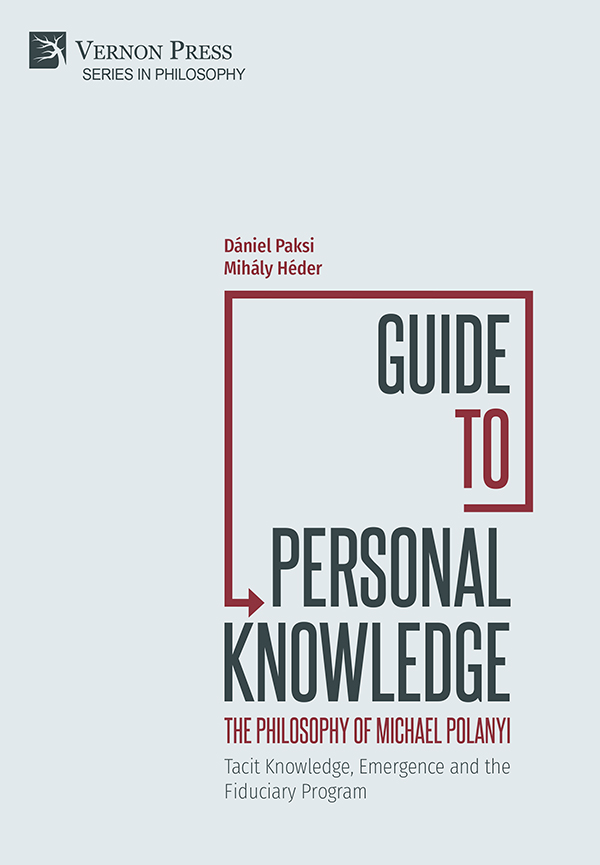
Tacit Knowledge, Emergence and the Fiduciary Program
Mihály Héder and Dániel Paksi
This book will help readers understand the most important book of Michael Polanyi, ‘Personal Knowledge’, and help them grasp the essence of his philosophical thinking. In this volume, Polanyi’s goals are first reconstructed, and then his main philosophical arguments are introduced. The discussion is limited to the most crucial ideas that are indispensable for the arc of his book: tacit knowledge, emergence and the fiduciary program. The thirteen chapters of this volume explain the essence of the thirteen chapters of ‘Personal Knowledge’. The page numbers in this book work just as well with the 2015 ‘Enlarged Edition‘ of ‘Personal Knowledge‘ as with the original issues. Whether you just want to get the key quotation and the context right on tacit knowledge, emergence or the fiduciary program, or want to have a deep dive for your scholarly research in philosophy and management, this book is for you.
Phil Mullins, Mihály Héder, Eszter Nádasi, Hakob Barseghyan, Maxim Mirkin, László Ropolyi, Jacopo G. Bodini, Anna Caterina Dalmasso, Alexandra Karakas, Balázs Horváth, Péter Neuman, Dániel Gergő Pintér, and Ákos Gyarmathy
Technology, in all its forms, has had and continues to have an indisputable impact on society and culture. Philosophy of technology seeks to understand this impact and the meaning of technology for society and culture. Although its origins can be traced back to the Greeks, it wasn’t until the late 19th century to the beginning of the 20th century that it gained ground as a philosophical discipline. Now more than ever it is considered an essential philosophical enterprise. ‘The Budapest Workshop on Philosophy of Technology’ was a lively and successful event that sought to discuss, reflect on and apply this branch of philosophical inquiry to both historical and contemporary examples. Importantly, the contributors’ methodological approaches were influenced by, although not limited to, Michael Polanyi’s term ‘post-critical’. Moving beyond the rigidity of past approaches, the selected essays were driven by two lines of inquiry, what has been the historical role of technology in social and scientific change? And, how can a ‘post-critical’ approach enhance and extend our understanding of philosophy of technology? This edited volume begins by exploring the role of technology in social and scientific developments from a historical perspective, before moving towards a discussion of philosophy of technology from a ‘Post-Critical’ epistemic stance. Free from the constraints of previous methodologies, the third part of this work engages with the term ‘Post-Critical’ in its broadest sense. The contributors to this section consider the phenomenology of the body and the influence of technology on our lives. Finally, the four concluding chapters of this book apply this philosophical approach to a wide range of contemporary problems from Decision Support Systems to Crisis Communication.