Browse by Subject
Explore our complete collection
Status
Format
Language
Publishing
Resources
News & Updates
About Vernon Press
Subjects
Series
Publication Status
Type
Loading...
Please wait while we load the content...
Kangwon National University, Korea
Dylan Motin
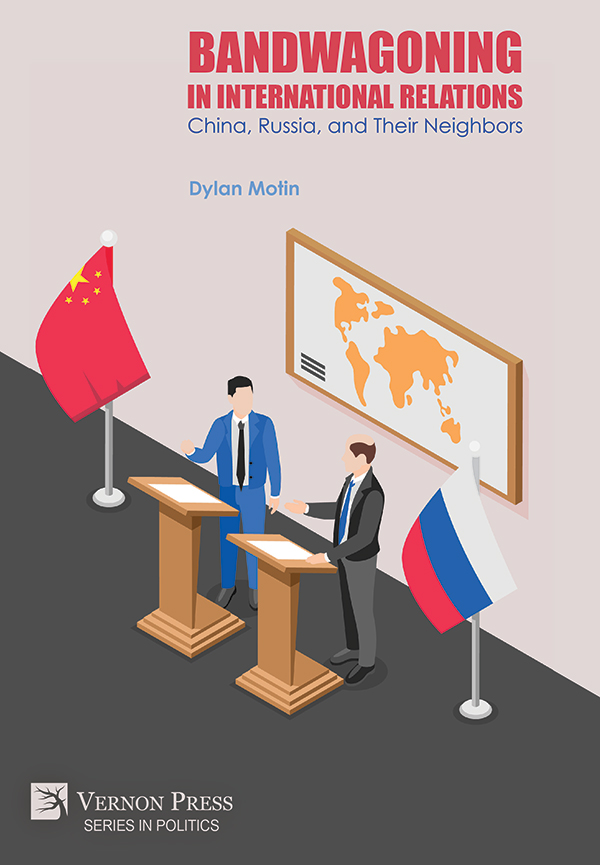
Whether states balance against or bandwagon with threatening great powers remains an unsolved problem for international relations theory. One school argues that military power compels minor powers to accommodate threats, while another defends that it elicits balancing instead. With the emergence of potential hegemons in both Asia and Europe — namely China and Russia — understanding state alignment is more urgent than ever. This book shows that bandwagoning has been a rare choice in contemporary Asia and Europe. The only states that chose bandwagoning with China or Russia faced both conflicts with third rivals and low levels of U.S. assistance. Going further, I divide bandwagoning between full alignment, survival accommodation, and profit accommodation. Bandwagoners choose among these three options based on the severity of the threat posed by the potential hegemon, the intensity of third conflicts, and the level of U.S. assistance. I test this novel theory against three European (Armenia, Belarus, and Serbia) and four Asian (Cambodia, Myanmar, North Korea, and Pakistan) cases. This study is the first to provide an exhaustive and compelling explanation of bandwagoning fully compatible with neorealism and adds to the balancing-bandwagoning debate. Beyond scholarly implications, this research’s findings offer advice for policymakers concerned with the changing balance of power in Asia and Europe and how to counter China and Russia’s influence.