Loading...
Please wait while we load the content...

Loading...
Please wait while we load the content...
Amity School of Languages, AUH, India
Gökhan Tekir, Iain Sinclair, James D. Seymour, Faiza Mazhar, Abby Fryman, Subhadra Mitra Channa, Mukesh Shankar Bharti, Mohamad Zreik, and Suvro Parui
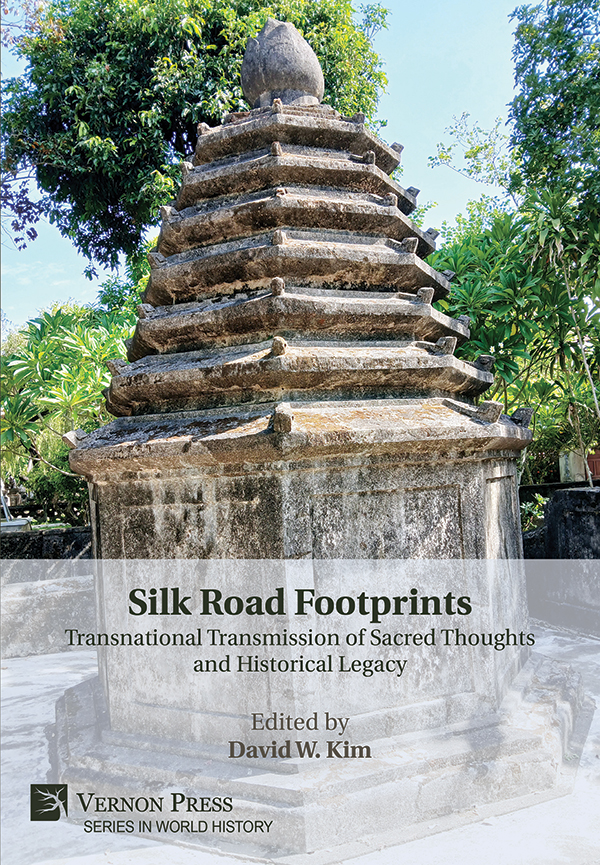
The Silk Road generally evokes images of places, cultures and peoples linked by the exchange of exotic goods and fabled treasures. The notion of the subject, however, often disregards the historical fact that the Silk Road routes functioned as a unique channel for spreading religious ideas, culture and literature. The personal or community beliefs of the Silk Road were changed radically as a result of the impact of external influences. 'Silk Road Footprints: Transnational Transmission of Sacred Thoughts and Historical Legacy' demonstrates that sacred communities interacted, coexisted, competed and influenced each other over long periods. These include those local traditions that evolved in ancient China, the Middle East, Africa, Central Asia, Korea and Japan and the subsequent larger traditions that arose in the region—Judaism, Buddhism, Christianity and Islam—as well as the shamanistic and animistic traditions of various nomadic peoples. The history of religions along the Silk Road is a remarkable illustration of how beliefs and civilisations often reflect a broad pattern of synthesis rather than clash. This book indicates that Asia (South, Southeast, East Asia and China), one of the most pluralistic religious regions in the world, has become a center of attention as a bridge between cultures. Ultimately, the creative study of the Silk Road and religious transnationalism evidences the implication that the local groups have been developed under the new environment of sacred principles and traditions as well as political influence.

Suvro Parui, M. C. Omar C. Vargas-González, Jérôme Dumetz, Mladen Adamovic, Raghavan Srinivasan, Priyanka Chadha, Anuj Kumar, Nicole S. Knight, Lisa Gibson, Barıs Ülker, Hasan Koç, Wenxia Guo, Etayankara Muralidharan, José G. Vargas-Hernández, Vinod Sharma, Chandan Maheshkar, and Levent Arslan
Culture is a 'cumulative custom of beliefs, values, rituals, and sanctions practiced by a group of people, province or country'. It is a more sensitive dimension of internationalization of any business and making it perform in a culturally diverse environment. Sometimes, nations/states lose their normative significance in a cross-cultural setting (e.g., India, South America). It is because they undermine their earlier philosophies of norms, values, and beliefs or neglect the cultural significance of other nations. In the current business and workplace dynamics, cultural components introduced significant changes in the core assumptions of business practices and skill expectations. This paradigm shift has forced business executives and managers to know how cultural differences affect inter- and intra-organizational functioning. It has made gaining cross-cultural compatibility a serious concern for business and academic communities worldwide. Therefore, this book facilitates business leaders, expatriate managers, business executives, academicians and scholars to explore different cross-cultural business perspectives and practices.