Loading...
Please wait while we load the content...

Loading...
Please wait while we load the content...
Binghamton University
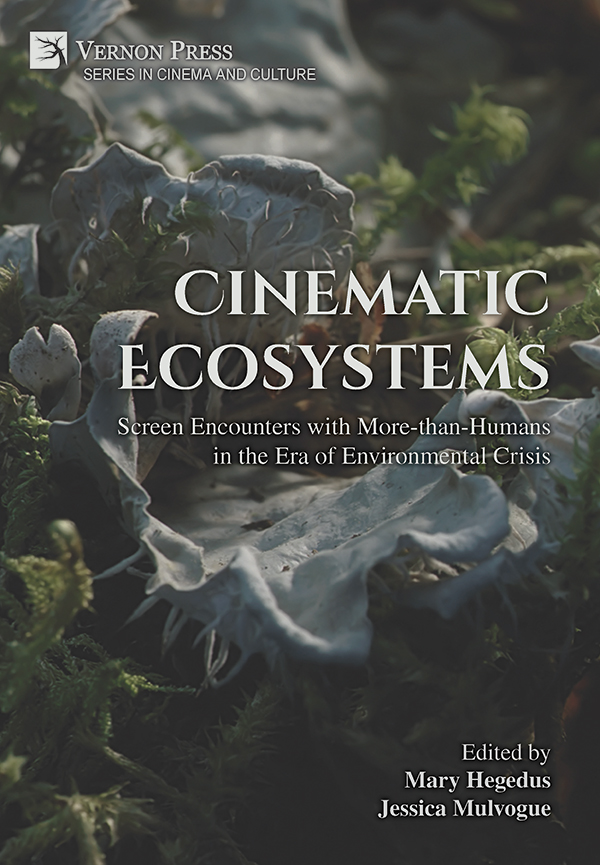
Marek Jancovic, Samantha R. Sharp, Elio Della Noce, Graig Uhlin, Emily Collins, Scott Birdwise, Mary Hegedus, Aarón Lacayo, Jennifer Schell, Ariadna Cordal, McKew Devitt, Zeke Saber, Melanie Ashe, Simon R. Troon, Belinda Smaill, Virginia Luzón-Aguado, and Brenda Longfellow
Motivated by the exigency of climate change, 'Cinematic Ecosystems: Screen Encounters with More-than-Humans in the Era of Environmental Crisis' takes cinema to be an audiovisual form whose creation and meaning are deeply connected to more-than-human worlds. As part of the third wave of ecocinema studies, this collection gathers contributions on multiple cinema forms from an international group of scholars and artists who offer diverse, critical perspectives that respond to the question: How does cinema help or hinder us in coming to know the more-than-human world? The collection homes in on the concept of the ecosystem as a biological and technological system that comprises a network of inter-relational living and their inanimate elemental affordances to explore encounters with cinema as a material object and practice, a spectatorial experience, and a representational text. The chapters cover environmental topics that span five continents and multiple histories. This book will be of special interest to film studies scholars and artists interested in cinema and climate change, environmental justice, and posthumanism.
Travis Dumsday, William H. U. Anderson, Şeyma Balcı, Floribert Patrick C. Endong, Vinod Balakrishnan, Anupama A. P., Zeke Saber, Stefano Bigliardi, Giese Ted, William Bowes, Matthew Small, Sarah Cameron, Justin McLendon, Robert Matikiti, John Paul Arceno, Erin Archer, and Jonathan Strand
Hollywood is a $40 billion annual business, one that is highly influential in culture. If we want to know who we are as individuals and a society, what we believe and what we value, we need to know and understand Hollywood and film. Make no mistake, Hollywood is neither philosophically, politically, nor morally neutral! Many studies demonstrate how movies “affect” us long before we have thought it through. In other words, Hollywood “smuggles” all kinds of ideas into our minds and hearts without us even knowing it. While Hollywood may be the biggest and most influential in the world, this book will demonstrate the growing international influence of film from India (Bollywood), Nigeria (Nollywood), Zimbabwe (Zollywood) and Yesilçam (Turkey). 'Film, Philosophy and Religion' explicitly and implicitly takes a philosophical approach to analyzing film theoretically and methodologically. There are topic and film-specific chapters that take a theological approach, and others that explore ideas like Affect, Axiology, Art Reflecting the Artist and Transcendence (Spirituality) of Film. Hermeneutics also have a central role in the book, including films based on biblical texts that act as interpretations of these texts and fill in the blanks (albeit speculatively by way of script and directors). Chapters also explore the philosophy of aesthetics and film realism which end with theology, while other chapters explore the incompatibility of science with religion, as well as a chapter on the timely topic of rape in Turkish film. The book’s scope goes from the “Horror of Evil in Ridley Scott’s Alien Universe” to “Love Can Thaw a Frozen Heart: The Philosophy of Love in the Frozen Films” (Disney Princess Narratives). This book represents international films and scholars. The diverse perspectives from theist to atheist—and everything in-between—are sure to spark thinking and generate talking points that provide something for everyone in an accessible format. It will be of great interest to university students and professors, scholars, seminaries, and the general public.
