Loading...
Please wait while we load the content...
Loading...
Please wait while we load the content...

Explore peer - reviewed titles across the humanities and social sciences - rigorous research, fresh perspectives, and scholarship that inspires dialogue across disciplines.
Stay informed about our latest publications, calls for proposals, and special announcements. As a subscriber, you'll also enjoy exclusive member discounts of 10%-20% on all orders. Join our community of scholars, librarians, and readers today.

From special discounts and global distribution partners to downloadable catalogs, flyers, and high-resolution covers, we make it easy to enrich your library’s collection. Access bibliographic data, explore subject-specific listings, and stay updated on forthcoming titles.
Become part of our librarian network and access dedicated tools, discounts, and resources to support collection development and promote new titles to your patrons.

Partner with Vernon Press to provide your customers with high-quality, peer-reviewed scholarship. We offer flexible ordering options, reseller agreements, and promotional materials to support your sales and outreach.

Vernon Press provides dedicated resources to help instructors adopt our books for courses and to support students with affordable access to high-quality scholarship. From desk and examination copies to tailored student editions, we aim to make our titles accessible in the classroom.

Charles Quince
This comprehensive study provides an essential examination of customary international law, addressing one of the most fundamental yet frequently misunderstood sources of international legal norms. The work bridges critical gaps in contemporary understanding through rigorous doctrinal analysis, extensive jurisprudential discussion, and illuminating case illustrations that demonstrate how custom operates within the global legal framework. As an authoritative reference tool, this volume serves legal scholars, practitioners, and students seeking to understand the complex mechanisms through which customary international law develops and functions, providing clear frameworks for identifying and interpreting customary norms across diverse legal contexts through its systematic approach to analyzing state practice and opinio juris. Beyond its reference value, the book offers practical methodological guidance for researchers investigating customary law formation. By examining evidentiary challenges and providing analytical frameworks, it equips scholars with robust tools for conducting empirical research on state practice and assessing the legitimacy of emerging international norms. The work’s structured approach to jurisprudential analysis serves as a valuable template for systematic legal research, while international law professionals will find the study particularly valuable for its practical applications in legal practice and policy development. The comprehensive exploration of norm formation processes, combined with detailed case studies, provides practitioners with insights essential for advocacy, treaty negotiation, and dispute resolution. Researchers benefit from the work’s contribution to theoretical understanding while gaining access to methodologies that enhance the consistency and reliability of customary law interpretation. This study ultimately advances the field by clarifying persistent ambiguities in customary international law, offering a more coherent understanding of its evolving role in contemporary global governance and legal order.
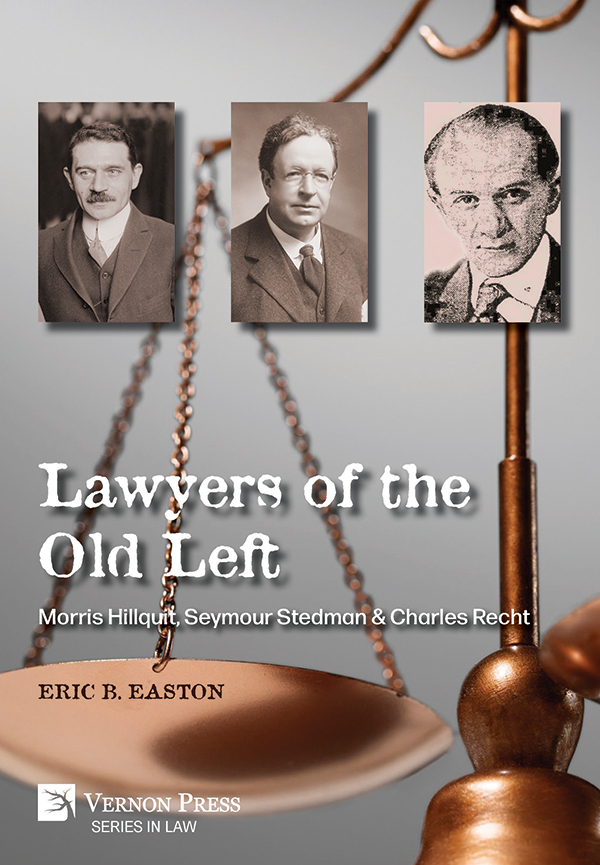
Eric B. Easton
'Lawyers of the Old Left' contains professional profiles of the three most important – if not the most famous – lawyers of the American Left in the first quarter of the twentieth Century. These men were involved in some of the most significant cases of the tumultuous era that surrounded World War I, and they all commanded the respect of both their contemporary colleagues and adversaries. Morris Hillquit was practically synonymous with the Socialist movement that flourished in New York City. Not only was he a prolific chronicler of the movement, but he also ran for political office several times under the Socialist banner. Hillquit took a leadership role in the defense of antiwar activists during wartime and the repression that followed. In time, he would become one of the nation’s pre-eminent labor lawyers. Seymour Stedman was a leader, with Eugene Debs and Victor Berger, of the home-grown Socialist movement that prevailed in Chicago, Milwaukee, and other midwestern cities. He rose to prominence at the national level, ultimately becoming the Party’s vice-presidential candidate in Debs’ campaign for the presidency in 1920. Charles Recht was unquestionably the most important American lawyer representing the Soviet Union, both before and after that country was recognized by the United States. He also participated in many important civil liberties cases, including the IWW and other anarchist-related cases. Recht also pursued a second career as a novelist, poet, and theatrical translator. Anyone interested in radical politics, the labor movement, and civil liberties law should be interested in reading this book. While these men played an outsized role in their time, they are largely forgotten today and appear only peripherally in the period literature. This book provides a perspective on the era that is otherwise largely unavailable.
Zoi Aliozi, Lu Shegay, Pierpaolo Petrelli, Alana Malinde S. N. Lancaster, Bolanle T. Erinosho, Hashali Hamukuaya, Tajudeen Sanni, Mark Chadwick, Ronald Rogo, Christine Okidi, Shabnam Moinipour, Henna J. Shah, and Vy Thuy Nguyen
'Blue Crimes and International Criminal Law' is a multi-author volume which explores the connection between criminal law and water (including our oceans and other bodies of water). The volume seeks to contribute to evolving discourse around water rights and water justice around the world. This novel volume surveys topics such as climate justice and blue crimes, water governance, illegal, unregulated, and underreported fishing, Rights of Nature, and examines the utility of ocean treaties and justice and accountability mechanisms within international criminal law, 'Blue Crimes and International Criminal Law' is a companion volume to 'Green Crimes and International Criminal Law.'
Mark Ellingsen
Critical Race Theory (CRT) is certainly a hot topic. No longer just the legal theory it was originally designed to be, it has become an icon for determining which side you are on concerning racism. Most of the loudest voices, especially in the debate about CRT in our schools, seem not to have actually studied the theory. This is a book to get you into the heart of CRT’s actual analysis and prescriptions. It’s a book to get Americans to stop all the shouting and really find out what CRT teaches. It might also contribute to getting more civility into our public discourse. Ellingsen demonstrates how in fact what Critical Race Theory teaches is in line with our Constitutional system’s realism about political solutions, suspicions of our selfishness, and the majority’s tendency to run roughshod over minorities. He also demonstrates that these commitments are consistent with Christianity’s understanding of original sin and the quest for social justice. Consequently, if critics do not want CRT taught in our schools or to be part of our public discourse, we had better stop teaching the Constitution and Christian values in our schools, to rule these commitments as out of order in our search for common values! Get ready for a stimulating, controversial, well-documented read.
A comparative analysis between Spain and Italy (1993-2015)
Stellamarina Donato
What stage of development are women’s rights as human rights? By specifically regarding the prevention and elimination of all forms of Violence Against Women, the book focuses on two European Mediterranean countries: Italy and Spain. The book first considers the chronological description and analysis of the main international documents, those belonging to the United Nations apparatus, followed by the analysis of the sources on Gender-Based Violence Against Women (GBVAW) of the Council of Europe and the European Union. The analysis of international documents guarantees an initial overview of the debate on GBVAW, following a top-down approach, from the UN to the national level. Successively, the focus is on both national sources as well as the level of government responsiveness in terms of policies on GBVAW in Italy and Spain, while also comparing the cases. The book adopts multimethod research based on qualitative text analysis; an examination of the level of national Government Responsiveness to GBVAW, and a series of in-depth interviews with targeted individuals. The final aim of this book is to understand how international (UN) and regional (CoE, EU) documents on GBVAW, along with the categories and expressions used within the documents, have contributed to different policies in countering GBVAW in Italy and Spain, while also highlighting the reasons why the two countries responded differently. Within a comprehensive international scenario, this book intends to create space for debate on possible future EU policies aimed at contrasting GBVAW.
Jose Noronha Rodrigues, Raúl Fernández-Calienes, Sofia Leitao, Dora Cabete, Tanya Herring, Isolde Quadranti, Blaž Lenarčič, Zorana Medarić, Dialechti Chatzoudi, Graça Santos, Sofia Bergano, Regina Bernadin, Cristóbal Pérez, Greg Carroll, Allan Shwedel, George Weagba, Joe Buttner, David Mercer, Amanda Francis, Sami Atif, and Richard Thickpenny
Communities around the world face challenges in how to assist the influx of refugees and immigrants, who arrive with only the clothes on their backs. They may have health problems and have experienced violence and trauma before they arrived in their new communities. They require healthcare, housing, education, jobs, financial & material support, and childcare, to name a few. Some arrive with families, but often, children and youth arrive unaccompanied and are in need of special care. Even well-intentioned and resource-rich communities may find themselves taxed as they struggle to help everyone in need. This book is framed by a human rights approach and highlights how social structures and institutional processes impact the lives of refugee and asylum-seeking children. Social institutions around the world tend to experience a similar type of challenge in serving this population. These challenges are examined in this book as recommendations for actions provided. The authored contributions present different perspectives on processes, interactions, policies, practices, and laws embedded in a variety of institutions and community social interactions. It is a reference for researchers, practitioners, and students in its presentation of academic and practitioner approaches to challenges faced by refugee children in different geographic and social contexts. Topics in this book include work on the character of transnational migrant families and communities, uses of new information and communication technologies, international frameworks of humanitarian assistance, social inclusion best practices in the integration of migrant children and unaccompanied minors, and models to provide multidisciplinary services on prevention, integration and rehabilitation integration strategies. Concepts of ACEs (Adverse Childhood Experiences) and HOPEs (Healthy Outcomes from Positive Experiences) are explored, along with lifelong learning as a catalyst for the sustained promotion of safe communities in the context of migration; and individual refugee needs and their family’s future wellbeing towards service to refugees that work for the individual.
A Pan-African Victory
Gnaka Lagoke
The International Criminal Court (ICC), created in 2002 to combat impunity, projects a sense of unfairness and stirs an unending debate. A trial before the court epitomizes the controversy surrounding it, perceived as a neocolonialist tool in the hands of the most powerful nations. This research critically examines the trial of the former president of Ivory Coast, Laurent Gbagbo. The two-decade crisis in Ivory Coast was a series of armed, diplomatic, and political conflicts in which human rights were violated by all sides. Military confrontation resumed as a result of an electoral stalemate that followed a controversial presidential election in the fall of 2010. The most atrocious human rights abuse was perpetrated at the end of March 2011 by the rebel forces backed by the French and the United Nations troops: the massacre of Duékoué. In one day, hundreds of Laurent Gbagbo’s followers were killed. However, the ICC undertook a selective prosecution against Gbagbo’s camp. After a trial of eight years, Laurent Gbagbo was finally acquitted. The news of his unanticipated acquittal shocked the world. Later, that decision was overturned and transformed into freedom with binding and coercive conditions by the Appeals Chamber, which had succumbed to political pressure. The former president of Ivory Coast spent months of confinement in Belgium until the Appeals Chamber rebutted the prosecutor’s appeal against his release and confirmed his total acquittal and that of Blé Goudé. He eventually went back to Ivory Coast on June 17, 2021. The trial of Laurent Gbagbo before the ICC, despite his acquittal (a tardy one), reflects a series of biases germane to international law and international justice, such as the victor’s justice stance, the conflict between national law and international law, the question of sovereignty, and the issue of lawfare. The trial of Laurent Gbagbo, which was the hallmark of the selective international justice system embedded in unfairness, led to a historical landmark with his shocking acquittal, which led to the indictment of the International Court, whose fate has thus been sealed before history.
Bruno Meini
***2022 NYC Big Book Award Winner in the category of Sociology*** En el mundo del siglo XXI, las epidemias son sucesos biológicos y sociales comunes y el VIH quizás lo enfatice mejor que cualquier otra enfermedad. Sin duda, la investigación científica médica ha dado importantes pasos hacia adelante; mientras tanto, el campo de la investigación social se encuentra todavía en sus etapas iniciales y muchos esperan una respuesta igualmente auspiciosa. 'Un Análisis Socio-Criminológico de la Epidemia del VIH' ofrece un análisis integral de las dimensiones socio-criminológicas multifacéticas de la epidemia del VIH y contribuye positivamente al debate sociológico en curso sobre las enfermedades infecciosas. El autor pretende crear una epistemología independiente del VIH para explicar las fuerzas sociales que impactan y determinan el curso y la experiencia de la epidemia, al mismo tiempo que busca replantear el discurso popular sobre el VIH para reflejar las conceptualizaciones sociológicas. Este último paso conduce a la identificación del concepto de interacción social como una herramienta adecuada para resaltar la compleja naturaleza social de este virus. El desafío sin precedentes que plantea la epidemia para la comunidad internacional exige una cooperación global dirigida a evaluar los diversos aspectos de los problemas que muchos actores de este trágico drama deben abordar. Dado su atractivo internacional de amplio alcance, este libro también se recomienda para aquellos involucrados o interesados en problemas de salud global y enfermedades infecciosas. Será de particular interés para los investigadores médicos, los trabajadores de la salud, los científicos sociales, los trabajadores sociales, los encargados de formular políticas, los trabajadores humanitarios, los activistas del VIH y los derechos humanos y los estudiantes de posgrado.
Chrystie Flournoy Swiney
In an increasing number of countries around the globe, representing all regime types, in all regions, with all levels of economic and military strength, civil society’s autonomy from the state, its defining feature, is diminishing. While a variety of tools are used to restrict civil society organizations’ (CSOs) independence from the state, an increasingly popular and dangerously effective vehicle for accomplishing this goal is the law. Through the passage of legislation that imposes new restrictions on the ability of CSOs to operate free from excessive government scrutiny and control, governmental actors are gaining greater control over the non-governmental sector and in ways that benefit from the veneer of legality. Perplexingly, such laws are not only appearing in countries where they might be expected – Azerbaijan, Burundi, China, Egypt, Ethiopia, Russia, Zimbabwe, and countries throughout the Middle East. Indeed, they are increasingly appearing in democratic states too, including strong, fully consolidated democratic states with historically strong and independent civil society sectors: Canada, India, New Zealand, Spain, Israel, Hungary, Poland, and the US, to name just a few. Restrictive CSO laws, which are unsurprising in authoritarian-leaning states, are uniquely puzzling in the context of democratic ones, which have been the primary defenders, funders, and champions of a robust and independent civil society. This book explores this concerning and intriguing phenomenon by documenting its full scope and spread within the world’s strongest democratic states and attempting to explain its occurrence. Using a combination of mixed methods – theory, process tracing, interviews, and statistical analysis – this timely analysis helps to shed light on a global phenomenon that seems to be fueling the democratic backsliding visible in an increasing number of democracies throughout the world. This exploration, which bridges comparative and international law, international relations, democratic theory, and state-civil society relations, attempts to make sense of this global contagion, the closing space phenomenon, which threatens to undermine one of cornerstones of any democracy – a free and independent civil society – in the years and decades ahead.