Loading...
Please wait while we load the content...

Loading...
Please wait while we load the content...
Stay informed about our latest publications, calls for proposals, and special announcements. As a subscriber, you'll also enjoy exclusive member discounts of 10%-20% on all orders. Join our community of scholars, librarians, and readers today.


Availability
In stock
ISBN
9781622730650
Edition
1
Publication Date
March 30, 2018
Physical Size
236mm x 160mm
Illustrations
88 Color
Number of Pages
344
Currency
Quantity
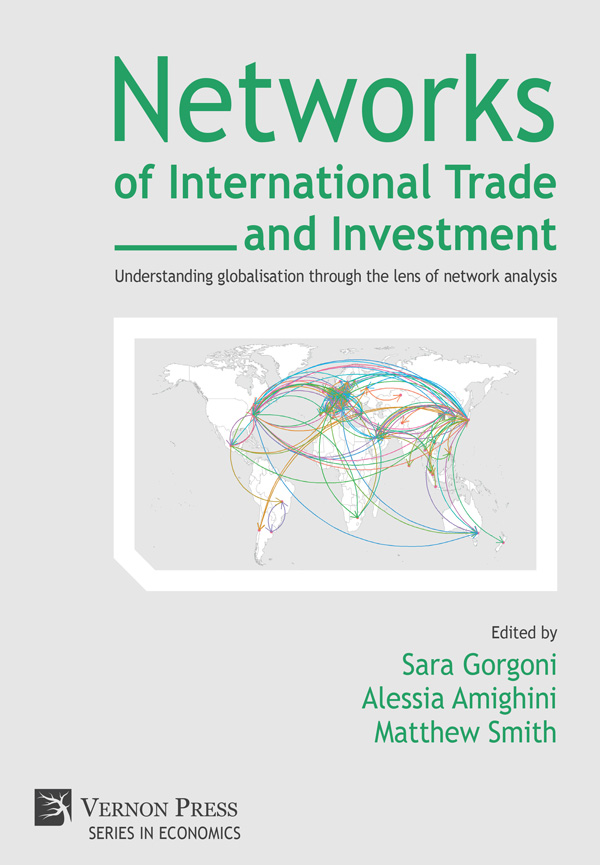
This book shows the potential contribution of network analysis to our understanding of the geography of a variety of socio-economic trends from migration to trade to foreign direct investment to the structure of the world input-output.
Grazia Ietto-Gillies
Emeritus professor of Applied Economics, London South Bank University
Visiting Research Professor, Birkbeck University of London
While there is a broad acknowledgment of the role of global value chains (GVCs) in the world economy, we are still at the beginning of their empirical investigation. At the macro level, input-output tables offer a powerful tool to assess all the inter-country and inter-industry transactions that culminate in the sale of final goods and services. At the micro level, case studies have implemented the GVC approach to understand the governance of specific value chains. In Networks of International Trade and Investment, Sara Gorgoni, Alessia Amighini and Matthew Smith have put together a series of novel approaches that deepen our understanding of GVCs and bridge the gap between the micro and macro analysis. Using state-of-the-art network analysis, the book provides new insights on the interdependencies that characterise trade, investment and global production. As compared to other empirical methods, network analysis allows to better identify the contribution of a country, industry or firm by not focusing on its own characteristics but by looking at how it is connected to others. As a consequence, new patterns and new structures emerge. The book includes many examples of how this approach can bring a fresh look to challenging research questions. While technical, the book remains accessible and can be read by a broad audience that includes policymakers. In the future, we could learn more by linking such analysis to economic performance. In particular, one would like to understand better how the position in the network is related to productivity or can bring specific economic gains.
Sébastien Miroudot,
Senior Trade Policy Analyst, Directorate for Trade and Agriculture, OECD
Discover books that expand on the themes explored in this work—titles that engage with similar questions, intersecting disciplines, and complementary perspectives to deepen understanding and broaden the conversation.
Browse all titles