Loading...
Please wait while we load the content...

Loading...
Please wait while we load the content...
Stay informed about our latest publications, calls for proposals, and special announcements. As a subscriber, you'll also enjoy exclusive member discounts of 10%-20% on all orders. Join our community of scholars, librarians, and readers today.


Availability
In stock
ISBN
9781648891229
Edition
1
Publication Date
April 12, 2022
Physical Size
236mm x 160mm
Illustrations
7 Color
Number of Pages
156
Currency
Quantity
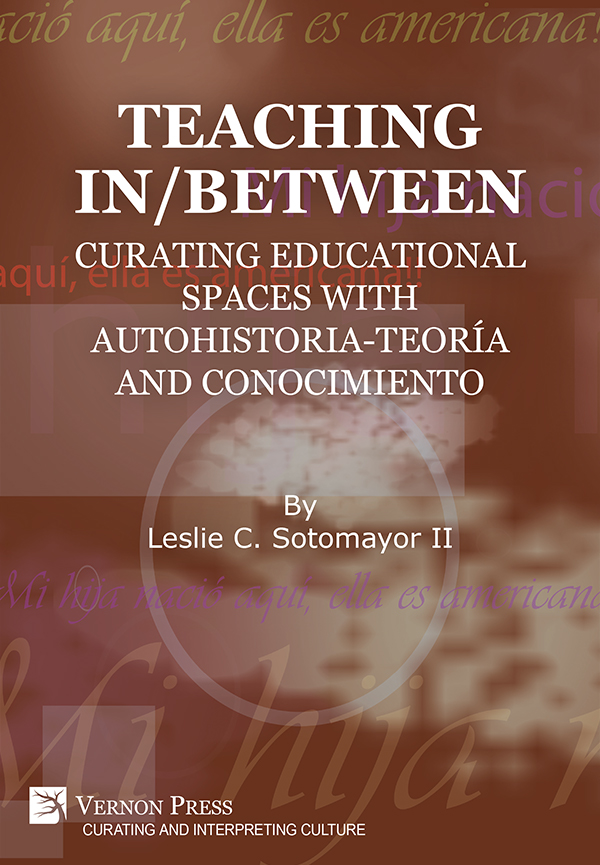
Leslie Sotomayor weds the transformative acts in Gloria Anzaldúa’s scholarship to her students’ and her own articulation of personal and collective testimonios. Using her course on Latina feminisms as her case study, Sotomayor decolonizes the privileging of white experience, rendering visible, instead, narratives that remain under-represented. The educator emerges as curator, as healer and messenger; curating, for Sotomayor, “is a concept and an action.” She articulates a glossary of empowerment that combines the Academy’s “trending terms” with a LatinX vocabulary that remains resolutely unitalicized. The banyan tree—a potentially essentialist metaphor—is transformed, in Sotomayor’s hands, into a historically-grounded, ancestral epiphyte.
[...] Sotomayor’s call to reform higher education is perfectly timed to respond to the contemporary climate of rising critiques of systemic racism and privilege in higher education and in the art world.
Dr Charlotte H. Wellman
Edinboro University of Pennsylvania
This book offers a critical intervention that very much recognizes teaching as an art — this is aside from academic discussions of teaching as performance. Instead, this book situates the authenticity of self through coming to know the self, which acts as a gateway to an interconnected and transformative classroom. In this space of interconnectedness based on lived experiences and story, the educator becomes curator encouraging active and communal learning, growth, and reflection.
Sotomayer offers educators everywhere much to think about in regards to how they approach their classrooms and what it means to decolonize a space historically rooted in imperialism and whiteness. Refreshingly, Sotomayer realizes this aim is far too expansive for any one book or paper, but does offer an important voice for consideration as we all unlearn the ways in which we have internalized the harmful narratives of colonialism. Sotomayer’s work also gives the reader a space to envision what these teaching practices could look like in a largely mediated space as our world shifts toward more digitally-based forms of connection.
Dr Stevie N. Berberick
Washington and Jefferson College
“Teaching In/Between: Curating Educational Spaces with Autohistoria-Teoría and Conocimiento”, by Leslie Sotomayor, is a groundbreaking and timely work which speaks to the nature of the school curriculum of the American Education system. The Author highlights the ways in which the school curriculum, wittingly or unwittingly, alienates minority and underrepresented groups and their cultural heritage from the mainstream White cultural dominance at all levels of the country’s Education System. She employs Gloria Anzaldua’s theories of autohistoria-teoria and conocimiento to argue her case, addressing and providing practical solutions that would help to decolonize the white hegemonic academic dictates of the current Education system and the alienating nature of its curriculum. A major strength of the book lies in the fact that the Author locates herself at the center of the study, recalling her personal experiences as student at the college level, and how she found herself almost completely alienated by the nature of the US Education system, as the curriculum relegated her Puerto Rican and Cuban-American cultural backgrounds and language to the fringes of the university courses. This experience thus motivated her to choose Autohistoria-Teoria, the genre of writing about one’s personal and yet, collective history because she strongly believed that her own experiences on a US college campus were not unique, as there are several groups within the country’s Education system similarly experiencing the alienation that she also went through. She supports her case, by incorporating stories from her students whose campus experiences also corroborated her story of alienation, lack of minority faculty, and the problem of heavy emphasis placed on the English Language, which completely reduces their presence on campus to near invisibility. Ms. Sotomayor’s Book is, therefore, timely, as it is greatly needed to support the current calls for international cultural diversity and inclusion at all levels of society. The book is a perfect recommendation for educators and students at all levels of the American Education system, the various School Boards and Districts and other similar educational bodies seeking to address and empower minorities and underrepresented groups struggling with cultural alienation within the American Education system. The author presents a simple, easy to read and understand writing style, which will appeal to most students and readers alike. The personal stories also make the work highly original, which many readers can easily associate with, in their own personal lives. She provides solutions and approaches to assist educators and school officials within the mainstream Education system, as well as students and curriculum experts, in attempts at implementing an inclusive education system that embraces all cultures and groups within the American society. It is a highly recommended book for the modern needs of students, educators, and all those involved in creating a society that is both diverse and unified at the same time, and in which all cultures and groups are equally represented.
Dr Clemente Abrokwaa
Penn State University
“Teaching In/Between: Curating Educational Spaces with Autohistoria-Teoría and Conocimiento” contains a well-documented overview and discussion of the relevance of feminist theory and the decolonization of the curriculum at all educational levels. While chronicling her personal experiences from childhood to receiving a Ph.D. in Art Education and Women's studies at Penn State University, Dr. Sotomayor skillfully merges the most current thinking regarding feminist theory, the decolonization of the curriculum and social justice. She uses the notion of “autohistoria-teoría" or self‐knowledge practices to illuminate the colonialization of the educational experience” in the United States' public schools. Sotomayor suggests that a reframing of the curriculum is necessary for the schools to provide an optimum education for every student. She proposes the creation of “curatorial education environments” that do not entail a regurgitation of information or a traditional banking system of education, rather a system that would be supportive of conversations with creative acts through individual and collective lived experiences, histories, and various contests. Dr. Sotomayor calls for the “decolonization” of the educational system and the provision of an education that integrates the soul, mind, spirit, and individual experiences into the learning process.
Dr. Grace Hampton
Pennsylvania State University
Discover books that expand on the themes explored in this work—titles that engage with similar questions, intersecting disciplines, and complementary perspectives to deepen understanding and broaden the conversation.
Browse all titles
Lee Davidson and Leticia Pérez-Castellanos
View more